




 Joaldo Lima
In recent years, the conversation about artificial intelligence has changed tone.
First, companies were impressed with chatbots capable of generating texts, answering questions and summarizing information. Now, the focus has moved to something more practical: artificial intelligence agents.
AI agents are not just conversational assistants. They can understand context, access systems, perform tasks, make decisions within defined limits and help automate real business flows.
What is an AI agent?
An AI agent is a system designed to act with some level of autonomy.
It receives a goal, interprets the context, queries tools, performs steps and returns a result. Unlike a traditional chatbot, which often follows a fixed tree of questions and answers, the agent works with context and actions.
Simple example:
- traditional chatbot: answers where the tracking link is;
- AI agent: identifies the customer, queries the order, checks the status, responds in the correct channel, updates the CRM and flags exceptions to a human.
This difference changes the role of AI within the operation.
Why have searches for AI agents grown?
The market has matured.
Companies don’t just want a curious experience. They want to reduce repetitive tasks, improve service, speed up processes and measure returns.
Searches for AI agents reflect real pain:
- slow service;
- manual screening of leads;
- overloaded level 1 support;
- teams repeating tasks on different systems;
- data spread between CRM, ERP and service channels;
- low predictability in operational processes.
AI agents enter precisely this gap between conversation and execution.
AI Agent for WhatsApp
In Brazil, WhatsApp is one of the central relationship channels.
Therefore, many companies are looking for AI agents for WhatsApp. The idea is to use AI not just to respond to messages, but to resolve customer service steps.
Common cases:
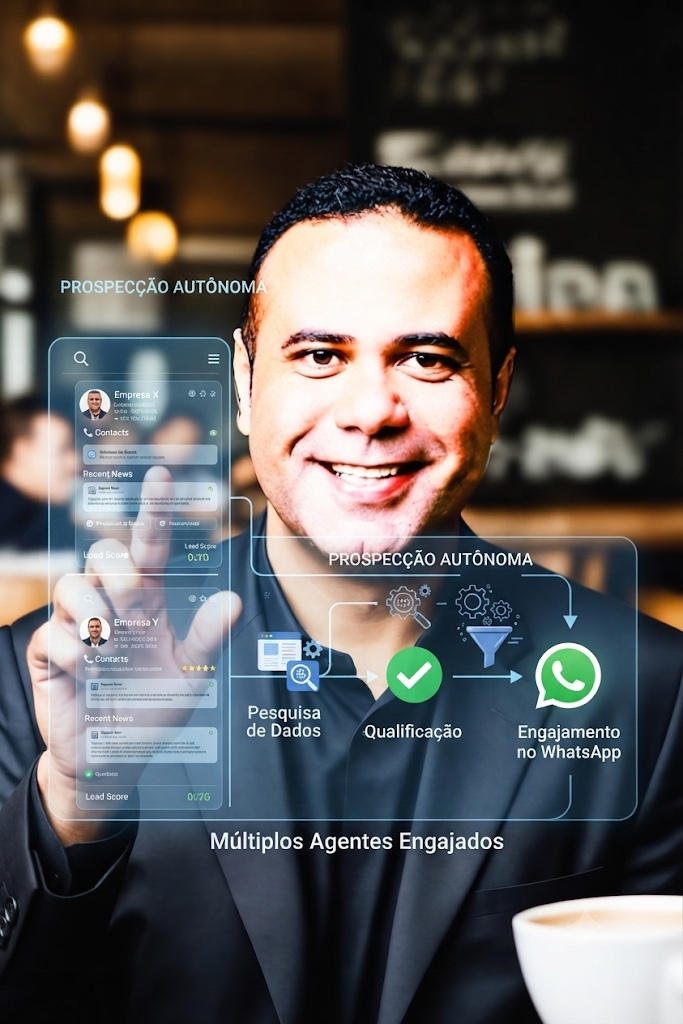
- lead qualification;
- order consultation;
- scheduling;
- initial support;
- customer recovery;
- CRM update;
- summary for human attendant;
- forwarding to the correct sector.
The care is not to turn everything into uncontrolled automation. The agent needs to know when to respond, when to query data, when to ask for confirmation, and when to escalate to a person.
Chatbot vs AI agent
A regular chatbot works well for predictable flows.
It can answer frequently asked questions, present options and collect basic data. The AI agent is best suited when the process involves context, decision and integration with tools.
Practical comparison:
| Resource | Traditional chatbot | AI Agent |
|---|---|---|
| Flow | Rigid | Adaptable |
| Context | Limited | Wider |
| Integrations | Punctual | Central part of the flow |
| Decision | Low autonomy | Controlled autonomy |
| Optimal use | FAQ and Routing | Processes, service and execution |
In practice, the two can coexist.
Multiagents and orchestrators
In complex processes, a single agent may not be enough.
Then the concept of multi-agents emerges: different specialized agents working together. One agent can handle sales, another can handle support, another can handle onboarding, another can handle finance.
The orchestrator coordinates this set.
It understands the intent, chooses the appropriate agent, follows the flow and ensures that the task progresses without losing context.
This architecture is useful when the company has multiple areas, specific rules and different systems involved.
MCP and connection to tools
One of the biggest recent advances is the standardization of ways to connect AI models to tools and data.
MCP, Model Context Protocol, is an example of this movement. The proposal is to facilitate the connection between agents, internal bases, applications and external services.
For businesses, this matters because an agent only generates real value when they can work with reliable data and useful tools.
Without integration, he talks. With integration, it executes.
Guardrails: autonomy with control
The more autonomy, the greater the need for limits.
Guardrails are rules, validations, and protections that help the agent operate safely. They define what the agent can do, what it cannot do, when it needs to confirm and when it should escalate.
Examples of guardrails:
- do not promise discounts outside the policy;
- do not access data without authorization;
- do not respond to sensitive legal topics without review;
- validate information before updating CRM;
- ask for confirmation before performing critical actions;
- escalate service when risk or dissatisfaction is detected.
Guardrails make automation more reliable.
How to get started with AI agents?
The best way is to start small and with an operational focus.
- Identify a clear bottleneck.
Choose a repeatable, measurable process with real impact. Example: lead screening, level 1 support, scheduling, registration update or status query.
- Define tools and data.
The agent needs access to reliable information. Map CRM, ERP, knowledge base, service channels and business rules.
- Create guardrails.
Define limits, allowed messages, escalation rules, sensitive data, and actions that require human confirmation.
- Measure results.
Track response time, resolution rate, escalations, satisfaction, errors, operational savings and impact on sales or service.
Conversational AI to Action AI
The big change is not just technical. It is operational.
Companies are moving out of the phase of using AI to answer questions and entering the phase of using AI to execute flows.
Autonomous agents do not replace the entire operation. They work best as team multipliers, taking on repetitive tasks and leaving humans focused on decisions, relationships and exceptions.
To achieve this, implementation needs to combine technology, processes, security and governance.
Tellegroup supports companies with communication solutions, B2B service, corporate SMS, cloud telephony and infrastructure for operations that want to evolve with automation and intelligence.
Speak to a Tellegroup expert and see how to apply AI and automation agents to your service flows.
-%20A%20Pro%CC%81xima%20Fronteira%20da%20Automac%CC%A7a%CC%83o%20Cognitiva%20%20.jpeg)