

 Joaldo Lima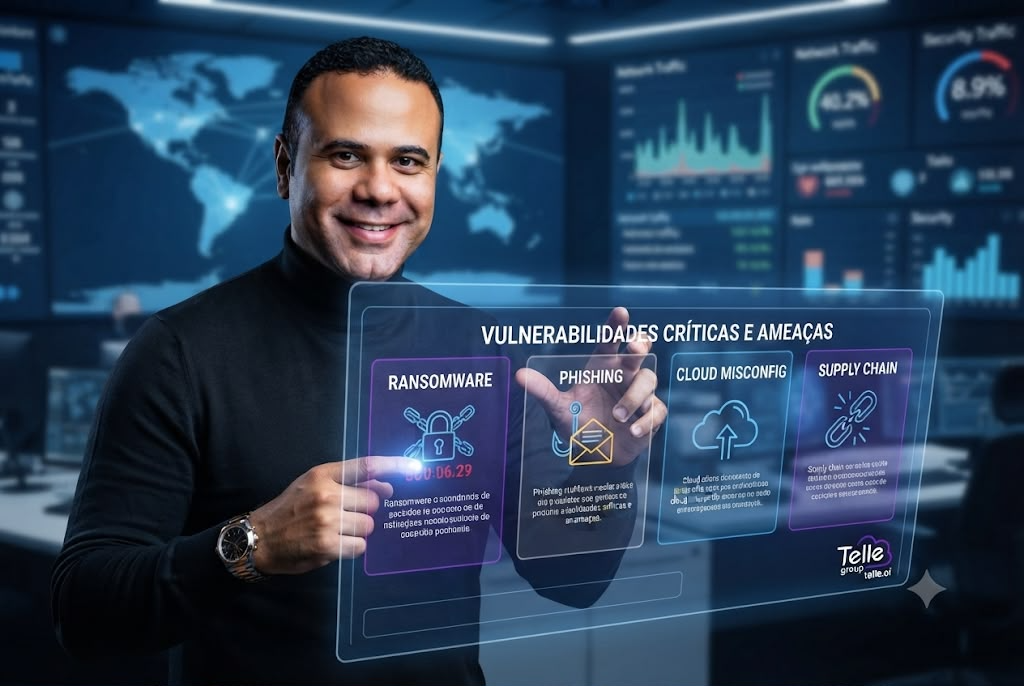
Cybersecurity in the Age of Hyperconnection: Beyond the Firewall, Where Do Invisible Risks Live?
In today’s corporate world, data protection has become the central pillar of digital survival. However, it is common for confusion to arise about the terms used. You may have heard of “cobersecurity”, but the technically correct term, and what you should look for, is cybersecurity.
Contrary to what many people think, cybersecurity is not just about installing a powerful firewall or hiring protection software. It is a comprehensive discipline that involves IT governance, risk management and an organizational culture focused on cyber resilience.
The illusion of the protected perimeter
Many organizations still invest heavily in edge defenses, ignoring that modern attack vectors operate far beyond the network perimeter.
Today, the attack surface is vast and often invisible. The risk is not just in the firewall, but in every connected system, integration, credential, API, device and vendor that participates in the operation.
Attack vectors that many architectures ignore
To strengthen your information security, you need to look for blind spots where traditional architectures often fail.
1. Connected physical security systems
IP cameras, turnstiles and IoT sensors often lack hardening and can serve as a gateway for attackers into the local network.
2. Supply chain risks
Blindly trusting third-party software, external libraries, and vendor updates without integrity validation can compromise an organization’s entire cyber defense.
3. Exposed APIs
APIs allow communication between applications, but they are also constant targets. Without strong authentication, access limits and monitoring, they facilitate leaks, credential abuse and data injection.
4. Cloud misconfiguration
Human error in the configuration of cloud buckets, IAM permissions and administrative access is one of the biggest causes of global data leaks.
5. Shadow IT
Personal devices and software not approved by IT create gaps beyond the control of corporate governance. What the company cannot see, it cannot protect.
6. Insider threats
Privileged access, when poorly managed, becomes one of the biggest risks in the operation, whether due to negligence, compromised credentials or malicious intent.
Building a robust defense
The transition from a reactive vision to a mature strategy involves several fronts.
From enforcing end-to-end encryption to strict two-factor authentication (2FA) policies, passkeys, identity management and network segmentation, every layer counts.
Compliance with LGPD and standards such as ISO 27001 should not only be seen as a legal obligation, but as a guide to digital security maturity.
Practices like DevSecOps, continuous monitoring, and threat intelligence help companies identify risks before they turn into critical incidents.
Security is a process, not a product
Security is an ongoing process, not a product you buy once and forget about.
By understanding that cybersecurity requires constant attention to vulnerabilities, anti-phishing training, access governance, and a holistic view of assets, your organization is better prepared to deal with invisible risks and evolving threats.