

 Joaldo Lima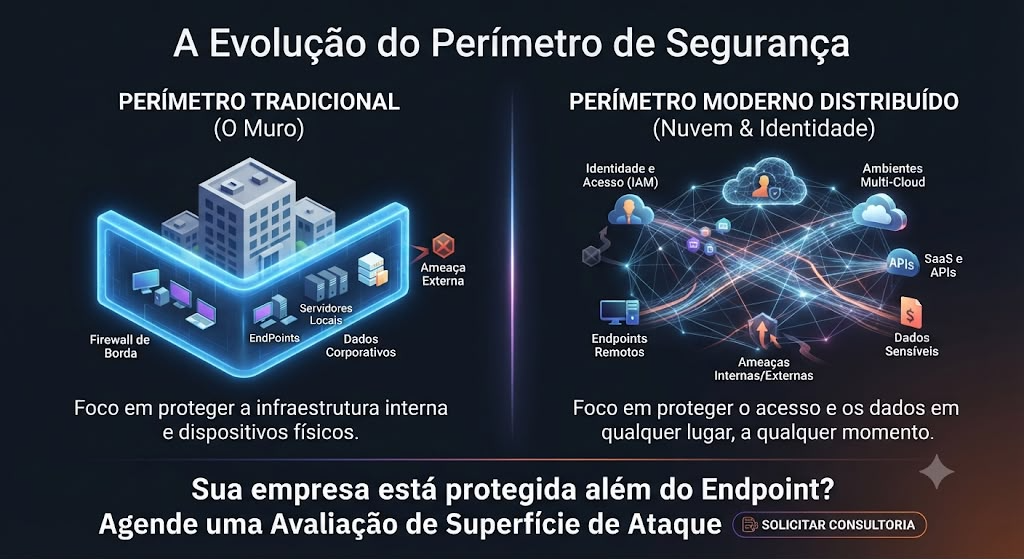
The End of the “Digital Fortress”: Why the Endpoint is no longer your only perimeter
The cybersecurity maxim for decades has been simple: “close the borders.” We build robust firewalls and invest heavily in protecting each end device, the famous endpoint.
But in today’s corporate landscape, this strategy has become a dangerous blind spot.
If you still believe that your company’s security depends solely on an antivirus or an EDR, Endpoint Detection and Response system, you are protecting the safe, but leaving the server room door unlocked.
The expansion of the attack surface: what has changed?
Digital transformation hasn’t just changed where we work. It has also changed how data flows, where identities operate and which systems participate in the corporate routine.
The attack surface is now fluid and made up of critical pillars that often do not receive due attention.
| Attack vector | Where is the risk? |
|---|---|
| Identity | Compromised credentials result in the attacker’s free pass. He doesn’t break down the door; enter with the key. |
| Cloud and APIs | Misconfigurations in multi-cloud environments can expose data without any traditional firewall noticing. |
| Shadow IT | Tools used by teams without IT governance create invisible security blind spots. |
Why is the isolated endpoint a strategic mistake?
The endpoint remains important, but it is just one node within a much larger network.
Focusing only on it ignores lateral movement. An attacker who gains access to a low-privilege credential on a commodity device can jump to cloud services, access databases, and exfiltrate information without necessarily triggering an antivirus alert on the original endpoint.
In other words: the endpoint is part of the defense, but it no longer represents the entire perimeter.
The new era: from lockdown to exposure management
To defend yourself today, it is not enough to block. It is necessary to adopt a proactive stance oriented towards the real exposure of the business.
1. Identity as a new perimeter
Implement Zero Trust. Don’t trust by default; check continuously.
Robust multi-factor authentication, least privilege policies, access review and identity management are no longer optional.
2. Continuous visibility
You can’t protect what you don’t map.
Attack surface management requires tools and processes that can look beyond known assets, identifying Shadow IT, forgotten integrations, and cloud misconfigurations in real time.
3. Behavior monitoring
Instead of just looking for malware signatures, focus on anomalous behavior as well.
An administrative account accessing financial data at 3 a.m. could be a more relevant warning sign than a traditional virus scan.
Modern security protects access and data
Modern security is a journey, not a destination or software you install.
By decentralizing your strategy and putting identity, data governance and continuous visibility at the center of protection, your company stops trying to build walls around a cloud and starts protecting what really matters: the access and flow of information.
Is your company protected beyond the endpoint?
Don’t wait for an invasion to discover your blind spots. Assessing the real exposure of the operation is the first step to reducing risk before it becomes an incident.