
 Joaldo Lima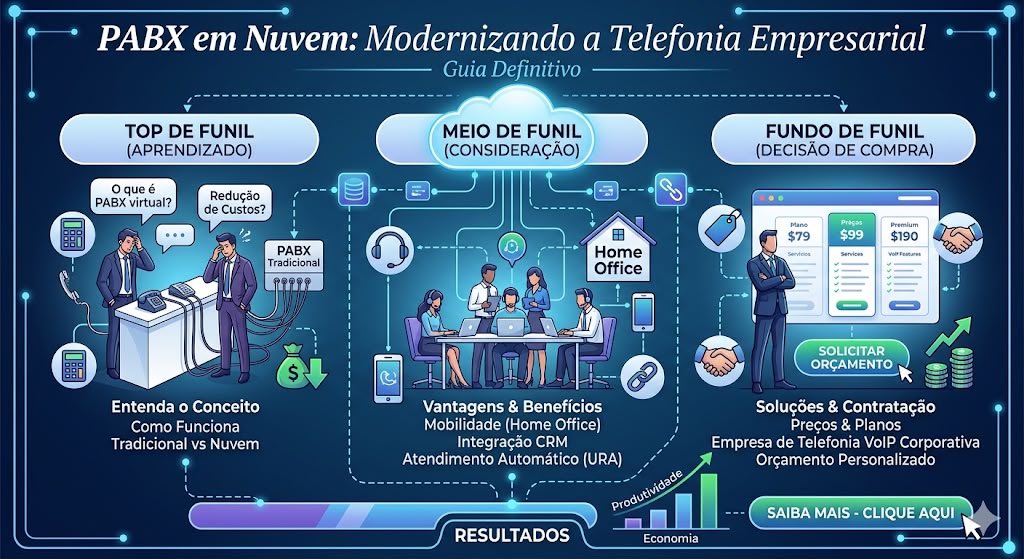
Managing the communication of a business requires flexibility, mobility and cost predictability. If your business still relies on complex wiring, expensive analog appliances, and plastered maintenance contracts, there’s probably room to modernize the operation.
Many managers look for how to reduce telephony costs in the company without giving up on the quality of service. The answer usually goes through cloud telephony, especially when the company needs to organize extensions, queues, IVR, recordings, mobility and remote service.
In this guide, you will understand what cloud PBX is, how VoIP telephony works and why this technology has become a solid alternative for companies of different sizes.
What is Virtual PBX and how does it work?
To understand the concept, it is worth looking at the traditional model. The physical PBX is a telephone exchange installed in the company, usually in a technical room, with cables, boards, appliances and local maintenance.
Cloud PBX, also called virtual PBX, eliminates much of this physical structure. It works digitally, using VoIP technology, which stands for Voice over IP. In practice, the call center starts to operate in a cloud environment, with extensions, rules and resources managed by software.
The operation is direct: the voice is converted into data and travels over the internet. As a result, the company does not depend on the same model of physical lines as traditional telephony. An internet-connected computer, IP phone, or smartphone can become a corporate extension.
Traditional PBX vs Cloud PBX
If the company still compares the two models, some points help to visualize the difference:
| Feature | Traditional PBX | Cloud PBX |
|---|---|---|
| Infrastructure | Local equipment, cables, boards and physical space. | Digital operation, with less reliance on local hardware. |
| Maintenance | Depends on on-site technicians and spare parts. | Upgrades and support can be done remotely. |
| Mobility | Extensions normally attached to the office. | Extensions can work in home office, branches and mobile devices. |
| Scalability | New extensions may require purchase and installation. | Extensions can be adjusted more quickly by the panel. |
This difference is important for companies that grow, have hybrid teams, operate with branch offices, or need to respond quickly to changing demand.
Key advantages of VoIP for business
Migrating to a cloud-based business phone system brings benefits that go beyond financial savings.
Mobility for in-person, hybrid, and remote teams
With cloud PBX, employees can serve customers from different locations, as long as they have authorized access and stable connection. This makes the solution especially useful for home office, external business teams, distributed support, and multi-unit operations.
More professional care with IVR and queues
Features like automated call answering, IVR, queues, time rules, recording, and transshipment help organize the customer experience.
In practice, messages such as “enter 1 for Commercial, 2 for Support” no longer depend on a complex physical center. The drawing can be configured according to the operation routine.
Integration with CRM and enterprise tools
Another advantage is the possibility of integrating telephony with CRM, customer service systems and internal tools. Thus, when a customer calls, the team can identify history, record interactions, and reduce rework.
This point is especially relevant for companies with consultative sales, recurring support, or high-volume service.
How to migrate the company phone to the cloud?
The migration to digital telephony is usually simpler than it seems, but it needs to be planned to avoid impact on the operation.
1. Evaluate the internet and network
The main requirement is to have a stable connection. A common benchmark is to consider about 100 Kbps per dedicated concurrent call, but the actual quality depends on latency, packet loss, jitter, firewall, and traffic prioritization.
Therefore, before migrating, it is worth reviewing data link, Wi-Fi, cabling, routers and network policies.
2. Plan for number portability
Your company can maintain the current number through portability where applicable. This reduces friction for customers who already know the company phone.
Ideally, you should plan windows, testing, and internal communication so that the transition happens with minimal disruption.
3. Define how users will respond
The company can service through IP phones, desktop apps, mobile apps, or a combination of these formats. The best design depends on the usage profile: reception, service, sales, support, remote operation or call center.
How much does cloud PBX cost?
When searching by cloud PBX price, it is common to find billing models by extension, by user, by resource, by package or by consumption. In general, the model approaches software as a service, reducing the need to purchase traditional servers, boards, and licenses.
The final cost depends on factors such as:
- number of extensions;
- volume of simultaneous calls;
- call recording;
- IVR and queues;
- CRM integrations;
- need for SIP Trunk, 0800 or specific routes;
- support, deployment and security requirements.
For micro-enterprises, the cloud can be an affordable way to have professional resources. For larger companies and call centers, the gain is often in scale, control, mobility, and operational management.
How to choose a cloud PBX solution
Before hiring, evaluate points that directly impact the operation:
- supplier stability and technical support;
- ease of management by panel;
- resources included, such as recording, reports, IVR and queues;
- quality of voice routes;
- experience with SIP Trunk, 0800 and corporate operations;
- ability to guide network, firewall and data link;
- commercial clarity on plans, boundaries and support.
Cloud telephony should not be seen only as a tool change. It is part of the company’s communication infrastructure.
Modernize communication with planning
Cloud PBX can reduce costs, improve mobility, and make care more professional. But the best result comes when voice, data, security, and operation are analyzed together.
Tellegroup helps companies design cloud telephony projects with Virtual PBX, SIP Trunk, 0800, voice routing, corporate SMS, firewall and data link.
If you are evaluating cloud PBX for enterprises, request a conversation with the Tellegroup team and understand which architecture makes sense for your operation.