
 Joaldo Lima
Technological evolution has gained unprecedented speed. On the one hand, digital transformation, automation and artificial intelligence drive productivity. On the other hand, cybercrime also uses these tools to refine approaches, accelerate attacks and exploit human error.
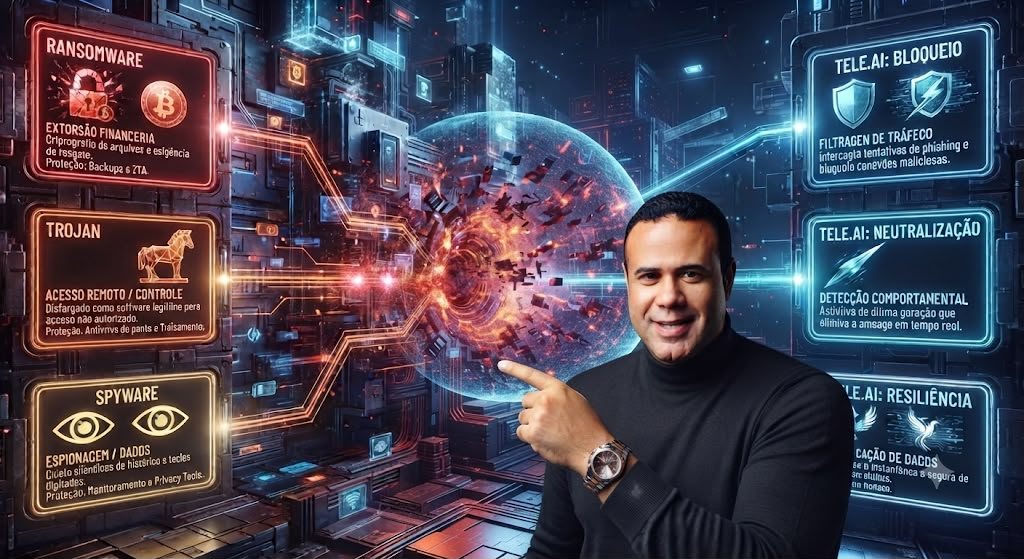
In 2026, one of the biggest risks to business continuity is ransomware supported by automation and artificial intelligence. The danger is not just in the malware itself, but in the combination of more convincing phishing, automated recognition, deepfakes and rapid exploitation of loopholes.
If the IT infrastructure still relies solely on static defenses, old rules and traditional antivirus, the company may be exposed. In this article, you will understand how the scenario has changed and which pillars help build cyber resilience.
What has changed in digital crime in 2026?
Until recently, many phishing attacks were relatively easy to identify: gross errors in Portuguese, suspicious links, generic messages and massive approaches.
With the maturity of generative tools and malicious automations, part of the attacks have become more personalized. Criminals can use public data, social networks, corporate information and communication patterns to create more realistic messages.
This makes prevention more difficult, because the attack no longer seems generic and starts to imitate legitimate contexts of business routine.
Personalized phishing with AI support
By analyzing public data from directors, managers, partners and teams, attackers can construct emails and messages with a tone closer to reality. In some cases, they even use voice or video cloning to simulate authority and urgency.
The objective is to convince employees to click on links, download files, transfer values, approve access or share credentials.
When this initial step works, ransomware can spread silently, seek out critical data, and begin encryption or exfiltration before the company notices.
Deepfakes and corporate social engineering
Deepfakes make social engineering attacks more dangerous. Audio that appears to come from an executive, a short video call, or an urgent message from a supplier can prompt quick, unvalidated decisions.
Therefore, internal processes need to provide confirmation through an alternative channel, validation of financial requests and clear rules for sharing sensitive data.
Impacts of AI-backed ransomware
Using automation can reduce barriers for criminals and increase the volume of attempts. For companies, the most relevant impacts appear on three fronts.
Faster encryption of critical data
Some attacks seek to identify the most valuable files, servers and databases before initiating encryption. This reduces reaction time and increases pressure on the company.
The less visibility the IT team has, the greater the risk of noticing the incident too late.
Evasion and adaptation of attacks
Modern attacks can vary behavior, change command infrastructure, test barriers and seek alternative paths within the network.
This scenario requires behavior-based defense, event correlation, and rapid response, not just blocking by known signature.
Growth of Ransomware-as-a-Service
The Ransomware-as-a-Service model allows criminal groups to offer tools, dashboards, and support to less technical operators. This increases the number of attacks and makes small and medium-sized companies more frequent targets.
Even organizations that don’t consider themselves major targets can be affected by automated campaigns.
How to combat malicious AI with modern defense
Purely human defense or defense based solely on static rules has lost effectiveness against current threats. To reduce risk, the strategy needs to combine technology, processes and culture.
Zero Trust: never trust, always verify
The Zero Trust model assumes that no user, device or system should be automatically trusted.
This involves strong authentication, continuous permissions review, network segmentation, context-based control, and behavior monitoring. If a credential is compromised, the impact tends to be minor.
Behavioral monitoring with EDR and XDR
Modern protection tools analyze user, device and system behaviors. Instead of just looking for known viruses, they look for signs of anomaly.
If an account starts accessing unusual volumes of data, running suspicious processes, or non-standard mass file encryption, EDR and XDR can help block the action and speed up the response.
Immutable and isolated backups
If the worst happens, the company cannot rely solely on negotiating with criminals. Immutable, encrypted, periodically tested backups isolated from the main network are critical to recovery.
The backup must not just be created; it needs to be restorable, auditable, and protected from inappropriate deletion.
Updated security culture
People remain an important line of defense. Generic training needs to evolve into realistic simulations of phishing, deepfake, financial urgency and credential theft.
Teams must know how to validate unusual requests, be suspicious of urgent messages and activate internal security channels quickly.
Anticipate the next threat
The damage from a ransomware attack goes beyond the ransom. It can involve operational downtime, data loss, regulatory fines, breach of contracts and reputational damage.
In 2026, digital security is not just an IT cost. It is part of the continuity, governance and trust strategy of any company that depends on data, connectivity and communication.
Tellegroup helps companies design safer network architectures, strengthen connectivity, protect corporate environments and mitigate risks so that the operation continues to grow.
Speak to a Tellegroup specialist and understand how to strengthen protection against ransomware in your company.